Without a doubt, real-time strategy games have come a long way over the past few decades, but we have to admit that, as modern players, we take some quality-of-life features for granted. For example, being able to select an entire army with a single click or send units across the map without worrying about them getting stuck is just part of the deal. It’s hard to imagine RTS games without these conveniences.
However, this was not always the case. Some of the genre’s most influential titles had not figured out how to make controlling an army less of a headache when they first came out. Sure, these games are extremely important in gaming history, but I have to admit that returning to their original versions today can be a frustrating experience.
Dune 2: The Building Of A Dynasty (1992)
Controlling An Army One Unit At A Time
Dune 2: The Building of a Dynasty is one of the most influential games in RTS history. It takes place on Arrakis, a desert planet where three factions compete for control over a resource called Spice. The idea is that you have to construct military bases, harvest resources, and defeat your opponents in real time. However, unlike most modern RTS games, Dune 2 does not allow players to select an entire group of soldiers or vehicles and give them a single command.

Find all 10 pairs
For example, if you have 15 tanks preparing to attack an enemy base, you must issue movement or attack orders to each tank separately, which is quite frustrating during large battles when your attention is so divided. Moreover, instead of allowing players to right-click a destination to move a unit or right-click an enemy to attack it, the game requires you to select the unit, choose an appropriate command, and then select the destination or target. Sure, you can use keyboard shortcuts, but they will not eliminate most of the busywork.
Enemy behavior is just extremely predictable. I’ve noticed that enemy forces generally attack the side of your base that’s facing their own position and can persistently target particular structures, so once you understand the patterns, you’ll just start exploiting them instead of coming up with different defensive strategies. I want to say that the game absolutely deserves enormous credit for helping establish the RTS formula, but its original version lacks many features that players consider seriously essential today.
Warcraft: Orcs & Humans (1994)
Four Units Are Apparently Enough For An Army
Warcraft: Orcs & Humans was developed by Blizzard Entertainment, and although it improved on several aspects of Dune 2, it also introduced some serious restrictions that most people will not appreciate today. For example, players can select only four units at a time. Sure, it does support group selection, and you can command several units simultaneously, but only four at a time, which kind of defeats the purpose. Imagine organizing an army of 20 soldiers; this would require five separate selections to issue the same order to everyone.
This restriction was completely intentional. The idea was for players to concentrate on smaller tactical engagements rather than overwhelming their opponents with massive armies. In any case, most people would agree with me when I say that this is just too restrictive. It’s important to mention that players rely heavily on Peasants and Peons to gather gold and lumber, construct buildings, and maintain their economy in general, so these workers must be carefully managed while players simultaneously control military operations.
In other words, there’s very poor automation in Warcraft: Orcs & Humans, which means that players spend considerably more time directing workers and monitoring activities than concentrating on strategic decisions. Moreover, the game has a comparatively small selection of military units and abilities, which, combined with all the other drawbacks, makes it painful to play today.
Command & Conquer (1995)
Your Soldiers Have Their Own Ideas About Following Orders
In Command & Conquer, players establish bases, harvest Tiberium, construct military units, and generally attempt to defeat their opponents across two separate campaigns. Although the game introduced several major improvements over earlier RTS titles, such as being able to select multiple units simultaneously, controlling them is not always a walk in the park. Generally, unit pathfinding is notoriously unreliable.
Units use a very simple movement system, so they often take inefficient routes, become separated from their groups, and even struggle to navigate crowded areas, which is particularly frustrating when you’re trying to control armies containing different types of vehicles. And don’t get me started on arriving together to face the enemy. This is usually impossible, as your forces will most often approach their opponents in smaller, poorly coordinated groups.
Lastly, even though the game features all kinds of infantry, tanks, and aircraft, there is almost nothing to allow most units to perform multiple specialized battlefield roles. For example, you can’t arrange formations to automatically protect vulnerable troops, which seems like a massive oversight when viewed through a modern lens.

Command & Conquer
- Released
-
September 26, 1995
Age Of Empires (1997)
Running An Empire Requires Far Too Much Babysitting
-
 Image via Xbox Game Studios
-
 Xbox Game Studios
-
 Xbox Game Studios
Age of Empires is all about guiding ancient civilizations through different historical periods, beginning with the Stone Age and progressing to the Iron Age. Generally, your purpose is to gather resources, develop new technologies, establish settlements, and assemble armies. Even though this game helped establish one of the most recognizable RTS franchises ever, the original version of Age of Empires lacks several features that are considered essential today.
For example, players are limited to a maximum population of 50 units; this includes both civilians and military forces. This means that if you want to build a larger army, you have to sacrifice some economic capacity, which can, in turn, slow down resource production. Even though population management forces players to consistently work on their strategy, this limit feels extremely restrictive when compared to modern games. Moreover, farms require constant manual maintenance, so when a military campaign demands your attention, you can suddenly run out of food because it’s very difficult to divide your attention. If that’s not enough, keep in mind that newly created units need more supervision than usual, which complicates the situation even further.
Another missing feature is the ability to quickly select idle villagers using a dedicated command. This means that there is no convenient way to locate workers after they complete construction, for example. Ultimately, even though Age of Empires is an impressive strategy game, the original title requires too much attention for routine management tasks.
Total Annihilation (1997)
Massive Armies, Questionable Navigation Skills
-
 Image via Cavedog Entertainment
-
 Image via Cavedog Entertainment
-
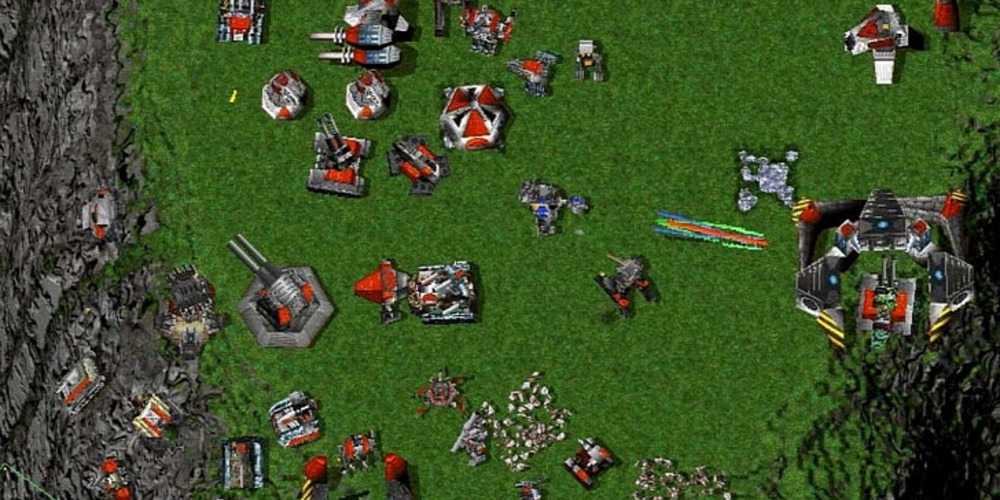 Image via Cavedog Entertainment
Total Annihilation is a science-fiction RTS revolving around two rival factions, the Arm and the Core. It features three-dimensional terrain, a great selection of military units, and an economy built around the production of metal and energy. I have to admit that this game was amazing when it came out, but it’s also true that some of its original systems are too frustrating by today’s standards.
One of the biggest problems with the title is that its pathfinding system doesn’t really handle armies very well. For example, units can struggle to pass through narrow areas, become trapped, or take inefficient routes, which means that players have to spend a ton of time correcting movement problems instead of concentrating on actually participating in battles. It’s important to note that Total Annihilation offers a lot of commands and automation options, which was impressive when the game first launched, but it does not provide a convenient zoom function for examining the battlefield at different scales. This often makes it difficult to determine how far away from you similar vehicles are.
Last but not least, Total Annihilation doesn’t consistently provide visual information to help players plan their bases. This makes it very hard to know whether a defensive structure can cover the area you’ve chosen, forcing players to learn everything through experimentation, practice, and persistence.

I’m Abhishek Sharma, an author at TigerJek.com. I enjoy exploring games, testing different strategies, and turning what I learn into clear, useful guides. My goal is to help players understand the game better and improve without the usual confusion.